Tougher Drunk Driving Penalties

Too often we act without thinking which leads to unfortunate consequences for ourselves and for those around us.

Several months ago, two of the most influential, kind hearted teachers (Mr T & Mrs T) at my High School Alma Mater were hit head-on in a devastating Drunk Driving Car accident.  Fortunately, they both survived, although Mr T suffered severe injuries.  He is currently undergoing rehabilitation and will likely be in that process for a long time.  It has had a devastating impact on his family and my hometown community where both taught for many many years.  They are some of the lucky ones though, many other families out there won’t ever get a second chance.

Ken Stoker, another of Marion’s wonderful High School’s teachers wrote an essay about the accident and Leandra’s Law recently, which was published in the Rochester Democrat and Chronicle.  I’d like to share that with you here to spread the word.

Enact tougher drunken driving laws

It was good to read headline news about “Leandra’s Law,” which went into effect in New York this past Friday. I applaud the new Child Passenger Protection Act but I feel it needs to be broadened to cover all victims of involved alcohol-related accidents.

While attorneys might go to court and argue that the driver of this and similar crimes deserves another chance because this had “only been a first, second or third offense” (what is the difference?), we all know that victims in such horrendous accidents do not even have the luxury of one day in court, let alone a “second chance.”

Their lives are either ended, or at best changed forever because of another’s irresponsibility.

Until several weeks ago, I guess I had been lucky to have only read or heard about such tragedies. This type of pain and suffering always had happened to “someone else.”

All that changed on Friday, Oct. 16, when two of my closest friends, professional colleagues and community leaders faced their own “near-death” experiences when their car was hit by another car driven by a man who had allegedly been drinking alcohol earlier that day.

He was charged with driving while intoxicated. Eight weeks after the accident, one of the innocent victims is slowly regaining limited movement.

It is a sad but familiar story.

These two accident scenarios are grotesquely similar, if perhaps only because they both have involved helpless victims whose lives have been taken or drastically changed in an instant.

And while there can never be any total guarantee that such events will never happen again to any one of us, a law with the same bite to it as the new “Leandra’s Law” needs to be enacted as quickly as this one has been to cover all victims of crimes involving drunken drivers, not just children.

We’ve all heard that “everyone makes a mistake and should be given a second chance.” That may work for some things, but not for the drunken driver.

I counter that neither Leandra Rosado nor the countless others who have been killed or maimed by drunken drivers’ reckless actions are really given a second chance to resume their lives normally.

Familiarity with the law should already count as that “first chance.”
Breaking the law should then be met with the same immediate and harsh punishment as outlined in “Leandra’s Law.”

~Ken Stoker – retired teacher of German and English, currently working around the world as an instructor for Academic Services International.

I’m appalled by these sorts of occurrences and disgusted by the lawyers who defend them.  If it were up to me, there’d be no second chances.  Stiffer penalties for those caught drunk driving, and permanent license revocation for those involved in an accident while under the influence.  No reductions, lawyer or no lawyer.

Broad Street

I love local history.  I work in an old company in an old building with a lot of history in an old City.  Recently they sent out some information about the different stages the area the building is in has gone through along with pictures from the Rochester Public Library and the Rochester City Hall Photo Lab of the area.  Since it’s public information I thought I should share it.

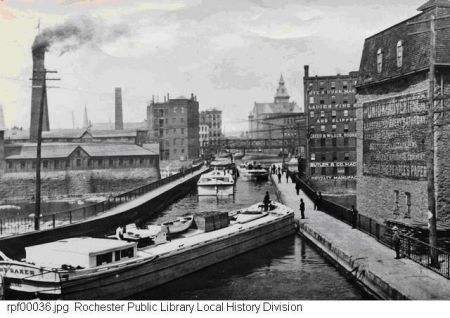
In this view from 1855, the new aqueduct runs past the ruins of the first one. In 1845 Josiah Bissell built a house using much of the sandstone from the first aqueduct, cleaning up the river for the city in the bargain.

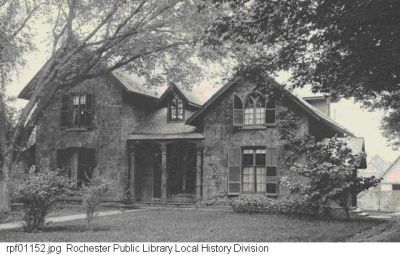
Josiah Bissell’s house, built from the red sandstone blocks of the ruined first aqueduct. See it today at 660 East Ave. at the corner of and Upton Park. It has since been expanded and is now the Rochester Methodist Home.

Rochester in the late 1880s, looking straight toward the future Aqueduct campus site. The Erie Canal and new aqueduct flow beyond the pedestrian lift bridges where Exchange St. now crosses Broad St. Old City Hall is at far left, looking much the same as it does today.

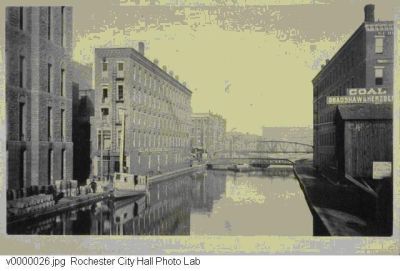
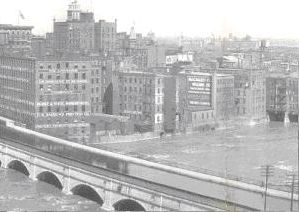
The Butts Building, newly built in 1895 with the familiar wedge shape. Six stories tall, two windows wide on the west side; six windows wide over the river. The new aqueduct and canal flow past at the first floor.

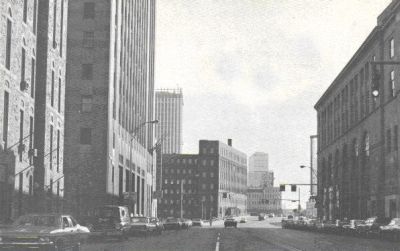
The same view in 1971. The Aqueduct Bldg. sports a new front entrance facing Broad St. at the second floor street level. Bldgs. 2 to 4 are complete. Bldg. 1 gained a seventh floor in 1951.

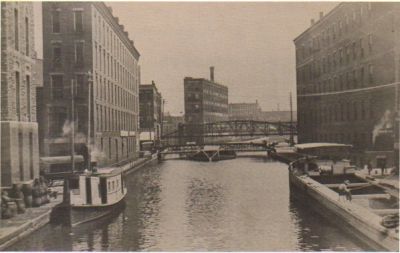
1897 photo of the busy aqueduct crossing the Genesee River. At left is the Kimball Tobacco Company, with the original location of the Mercury statue just visible above the smokestack. At right is the six-story Butts Building, shown here as the home of the Utz & Dunn shoe factory.

Sometime around moving day, circa 1901. Bldg. 1 with the names of Utz & Dunn and other former tenants scrubbed off. Names of the Lawyers Co-operative Publishing Co., Burke & White Bookbinders and E.R. Andrews Printing Co. will soon be painted on.

The Aqueduct Building in 1906. Note that Bldg. 1 has no seventh floor yet. Bldg. 2 will soon replace the four low buildings next door. McCauley-Fien Milling Co. has the white sign further downriver. At far right, four-story buildings line the Main Street bridge, hanging over the river. The original Democrat & Chronicle building is next to them on the riverbank.

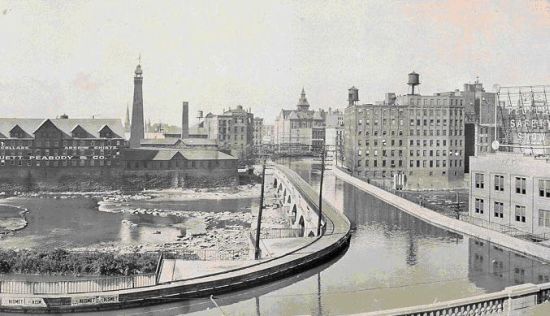
In 1917, two years prior to the transition from canal to Broad St., Bldg. 1 is still six stories tall, but Bldg. 2 has arrived with seven floors. Today’s Bldgs. 3 and 4 don’t yet exist. Cluett, Peabody & Co., makers of Arrow shirts and collars, occupies the old Kimball Tobacco Company.

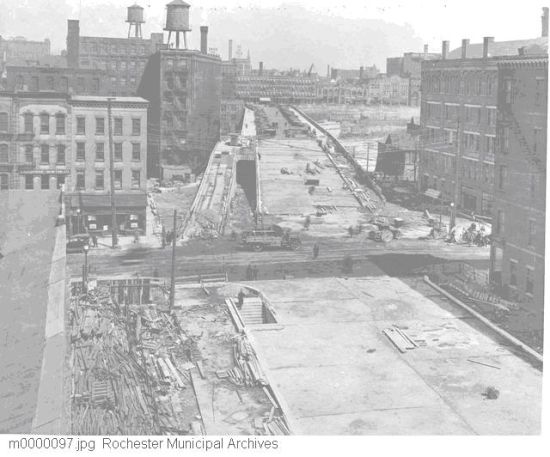
1925 photo: Looking east, construction of the subway in front of the Aqueduct Building. The Broad St. bridge temporarily serves as a parking lot. Note the long pedestrian ramp exiting the subway between the street and “our” sidewalk. Also, note the man walking down the stairs into the subway at the corner of Broad and Exchange streets.

The same view in 1927. Note the completed pedestrian ramp and subway stairs from the earlier photo. In the distance, Broad St. ended at South Ave. and the Osburn House hotel. The Rundel Library didn’t start construction until 1933. Standing on the future site of the LCP parking lot, the large “Bee Hive Building,” or RG&E power station No. 25, dwarfs the Herald Bldg. (B5) next to it.

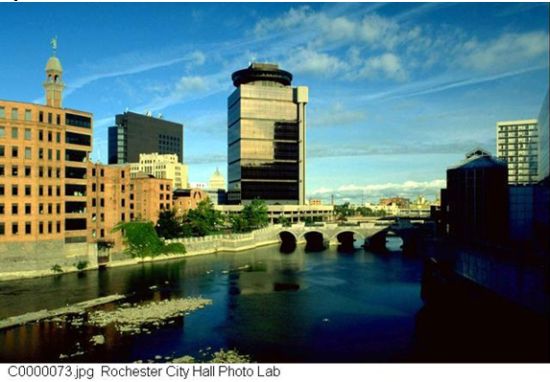
Present-day view of the river and aqueduct buildings, looking towards the Main St. bridge. Aqueduct Park graces downtown Rochester and the statue of Mercury once again stands tall on the Rochester skyline.

Jeffrey Mullin

My niece’s brother, Jeffrey Mullin, was recently shot and killed in Rochester NY. It’s always extremely sad when someone so young passes away but when it’s from such a violent act it hits twice as deep. Unfortunately Rochester is one of the most violent cities in America and we live and work right smack dab in the middle of it. People here often dismiss the murders in Rochester to the gangs and somehow believe it doesn’t happen to good citizens. Try telling that to Cassandra, my niece. Somehow I think you will come away with a different opinion.

It’s time to wake up Rochester. We need more police presence and we need better schools. According to the 2006 census there’s roughly 200,000 people living in the city of Rochester. There were 54 Murders here in 2005 and 50 so far in 2007. That’s roughly 1 in every 3700 people. Put another way, thats almost 27 people for every 100,000. That’s almost four times the national average (which is only 7)!

The Democrat and Chronicle has a piece entitled Not Forgotten where they list each of this year’s murders and have short slide shows dedicated to them. I think this is important. I think people forget that these murders are more than just statistics and that every one of the people lost was important to someone.

I copied Jeff’s slide show for my niece and I thought I’d share it with everyone, so they could learn a little bit about Jeff instead of hearing about number 50.

I’ve also uploaded the original in case anyone wanted a copy to share.