Diamond Sportsmen’s Club Agrees to Cumbersome APA Permit
Personal Monitoring, APA-Managed Logging, Biological Survey Imposed
By Carol W. LaGrasse
July 2002
The State’s 1998 acquisition of the 139,000-acre Champion International lands in the northern Adirondacks gave hunting club leaseholders on timber industry tracts a wake-up call. All 298 hunting camps are slated to be demolished, including those camps on the 110,000 acres of land where a forest management corporation will hold title to the underlying land with the State owning conservation easements.
Early in 2001, The Nature Conservancy announced that it was acquiring 26,000 acres near Long Lake in the Adirondacks from International Paper Company, where many hunters hold camp leases. More uncertainty was created for such leaseholders at the time, as the land preservation organization divulged incomplete plans to sell some of these lands outright to the State of New York and to make a timber management arrangement on other of the lands with conservation easements involving the State.
Responding to the growing threat to the future of hunting camps in the Adirondacks, the Diamond Sportsmen’s Club organized with an ambitious plan to become independent of timber company leaseholder status. Key members of the new club belonged to the Barney Pond Club, which leased the land for their hunting and fishing camps around a 37.8-acre pond from Lassiter and Diamond International. The sale of the land where the Barney Pond Club was located endangered the future of the lease, and the cadre of alert members moved quickly to acquire the 3,283 acres near South Colton in St. Lawrence County where the club had existed for 46 years.
“Private ownership of land in the Adirondacks is best for the people of the North Country,” declared Richard Todd, the president of the Diamond Sportsmen’s Club, in a letter published in February 2001 in the Press Republican, the Plattsburgh daily. “The ‘good old days’ are gone when we could count on leasing property from the timber companies for recreational use.”
During the latter half of 2000, the club executed the purchase of the Barney Pond Club from the new owner, Lothair, Inc. On the property were 42 existing camps. To make the $1,360,000 purchase financially viable, they invited additional members, who would build their own camps on the property or use the existing ones. In addition, they made a provision for recreational members who would have extensive rights to use the land, but not have their own camps.
“You can own a piece of the Adirondacks,” enticed the flyer that the club distributed. It offered the public individual transferable memberships, with the one-time payment of $5,000. All members would pay annual dues, the amount depending on their status as hunting and fishing camp owners or recreational members. In addition, the camp owners would pay the real estate taxes on their buildings.
The club’s fall 2000 announcement projected that the final size of the club would be about 125 to 150 full memberships, each entitled to a camp, in addition to 50 to 75 recreational memberships.
The Adirondack Park law gives an exemption from APA jurisdiction for hunting and fishing camps of less than 500 square feet in Resource Management zones and no square footage limitation in other land categories. This exemption was one of the important concessions that powerful local Assemblyman and Majority Whip Glenn Harris won in the course of the battle with Governor Nelson Rockefeller over the passage of the final form of the Adirondack Park Agency Act in 1973. The obvious interpretation of the provision is that the sportsmen would not have to apply to the APA for permission to build additional hunting and fishing camps of any size in Rural Use areas, where 68 of their 76 new camps are to be located. The other eight new camps are to be in Resource Management.
Over the recent decade, it has been observed that the Adirondack Park Agency does not like to see hunting and fishing camps constructed under the exemption, especially when several are contemplated. Informed sources say that the APA staff warned the Diamond Sportsmen’s Club that it would not be able to escape the jurisdiction of the agency. Instead, the staff persuaded the club that they should apply for seasonal residences instead of building “hunting and fishing camps.” They enticed the club into more elaborate plans with the idea that the upgraded status of the buildings would be beneficial to the club members because there would be less restrictions on the buildings and that the buildings would be larger.
However, once an applicant is involved in negotiations with agency staff, elaborate permit conditions very often attach themselves to the application, driving up the cost of the project and generating future encumbrances on the operation of whatever facility is contemplated.
At the official monthly APA meeting on June 13, 2002, the staff presented the draft final application from the Diamond Sportsmen’s Club to the APA commissioners. The results, although predictable, were disappointing. The number of new camps had been decreased to 76, making a total of 117 (considering that 41 of the existing camps are to remain), rather than the “125 to 150” advertised by the club or the 155 that were in the club’s original application. The club has already filled 119 full memberships, which is the camp-holding category.
The club has already received one recreational, non-camp owning, membership of the “50 to 75” originally advertised. At the June 13 APA meeting, Project Review Officer George Outcalt told the commissioners, “Applicant may not do any more recreational memberships.” An outside observer familiar with the APA could conclude that the APA staff has imposed a moratorium on the club’s recruitment, at the current total of 119 full members and one recreational member.
The only other construction allowed beyond the individual camps or “seasonal residences” would be expansion of the 480-sq. ft. clubhouse with a 720 sq. ft addition. At the entrance to the club’s property, the club would be allowed one sign set well back from the road, with only the club name displayed. Gone would be the invitation to join the club that has been proudly announced on the signs by the roadside.
Describing the buildings of the former Barney Pond Club at the APA meeting, the agency staff showed slides of the existing camps, including 30 that predate the APA Act, according to the monthly Adirondack Park Agency Reporter, published by Susan Allen of Keene Valley. Nearly all the existing camps are very small and modest, with no utilities. Instead, they have outhouses, gray water systems, and wood or propane stoves. Some have on-site generators.
The new buildings are considered a subdivision into sites for “single family dwellings,” not “hunting and fishing cabins,” according to the 29-page final APA permit. Yet, 70 of the 76 new camps would be built without electric power, telephone service, wells, and indoor plumbing. The six buildings that would have modern services are all located on a town highway, Raquette River Drive. The prohibition of indoor plumbing for all but six of the camps is inconsistent with the staff expert’s determination that soil conditions are suitable for septic systems. Even more questionable from the point of view of public health and convenience is the permit requirement that the same 70 camp owners must carry in their drinking water. It seems that the buildings are really camps rather than single family dwellings.
To add insult to injury, the permit spells out the details of underground disposal leach fields that must be built for the waste water, as though there could be any pollution potential from a few daily buckets of water from a kitchen sink without running water. Imposing further wasteful expense, the permit requires that existing “wastewater disposal systems” less than 200 feet from a pond or stream have to brought into “compliance” with the permit conditions for new systems.
The floor area limitation of 1,000-sq. ft. seems at first glance to be double that allotted in the law for hunting and fishing cabins for Resource Management areas. But the permit application has the unusual inclusion of decks, porches, and even small sleeping lofts in the total floor area. Furthermore, trailers are prohibited except for temporary use during the construction of the site-built camps. The trailer prohibition was originally self-imposed by the club, but the club allowed this clause in their rules to be written into the permit, putting this rule under control of the APA, rather than the members.
Other landscape restrictions are that the cabins must be “a color that blends with the surrounding environment” and buffer strips around Barney Pond with no vegetation cutting for a distance for 300 ft deep without APA approval in the form of a new or amended permit. These requirements contrast with the APA law, which spells out the amount of cutting allowed around water bodies as 30 percent of the shoreline on any lot. The APA staff and its non-profit alter-ego, the Adirondack Council, invariably chip away at the amount of cutting allowed in law as supposedly too generous. In fact, the club’s permit points out that the Adirondack Council withdrew its request for a public hearing when the number of proposed camps was reduced from 155 to 117 and additional vegetative cutting buffers were imposed around Barney Pond and a stream that runs through the club’s land.
Future Bonds to the APA
Far-reaching parts of the permit impose requirements for APA management of the club’s land in the future.
The club must prepare a forestry management plan for the APA’s approval. This intrusive involvement of the APA could impede the plans that the club originally announced that there would be marketable timber on the harvested land in ten to fifteen years. In addition to forestry issues, the permit requires the plan is to “minimize the potential for conflict with recreational uses of the project site by club members.” Not only does this provision set the stage for bureaucratic dealings with the APA, which, under the permit must approve the plan before any trees are harvested, but the provision could also set the stage for litigation by an obstructionist club member dissatisfied with the degree of preservation or upset about the look of logged-over land.
But another provision could be far more expensive and cumbersome. This is the requirement that the club submit to the APA a biological survey prepared by a professional ecologist. This final permit requirement is less onerous than the draft permit requirement for a natural resource management plan that would include “an inventory of vegetative and wildlife components,” recommendations for their “enhancement and protection,” and address recreational conflicts with resource protection. According to the Reporter, Mr. Outcalt told the commissioners on June 13 that the club asked that the resource management plan be eliminated, but that the staff did not recommend that. The APA’s staff member Ray Curran stated that the biological inventory was needed because, “We have a rare plant somewhere near the site; we think the habitat might be there.”
The Reporter pointed out that one of the APA Commissioners, Frank Mezzano, who is well-known locally as the former supervisor of the Town of Lake Pleasant and a member of the Hamilton County Board of Supervisors, remarked at the first day of the two-day commissioners’ meeting that the natural resource and monitoring plans “are particularly onerous to me.”
As finally passed during the second day of the commissioners’ meeting, the imposition on the sportsmen’s club includes a two-phase resource management plan: a qualitative biological inventory to be completed within three years and a resource and recreation management plan before any new land use and development in the future.
Commissioner Mezzano took strong exception to the management and monitoring requirements even after the resource management plan was modified for the final commissioners’ vote on the second day of the meeting. “I’m very supportive of the project but I still for the record have to voice my consternation about the biological inventory, the resource management plan, and the monitoring plan,” he stated for the record, according to the Reporter.
The qualitative biological inventory requires that an ecologist identify “any rare, threatened or species of special concern, or NY Natural Heritage Program species or communities listed as S1 or S2,(1) deer wintering concentration areas, natural fish spawning areas, as well as surface waters or special habitats.” For a full description of this potentially costly permit condition the permit holder is referred to an eight-page document called “Guidelines for Biological Survey,” which contains only a two-paragraph description of a “Qualitative Biological Survey.” The description sheds little light on the standards for mapping and detail of the required inventory. The only indication of the degree of detail required is a list showing the names of three past qualitative biological surveys and a reassurance that, “In large projects it is not expected that the biological survey aspect would total more than one half of one percent of the value of the project.”
To gage the potential impact of the requirement of a natural resource inventory, it is only necessary to recall that the Whitney’s withdrew their application for the subdivision of 15,000 acres of their 45,000-acre estate several years ago because the APA imposed the requirement for a biological inventory of the entire estate. At the time that the Whitneys dropped their application, an informed source said that this requirement was the reason that the Whitneys dropped the project. Later, the 15,000 acres were sold to the State of New York.
A most unusual encumbrance on the operation of the club is the requirement for a “monitoring plan” to be approved by the APA. This plan is to include a mechanism for recording how many members and guests are on the site on a daily, weekly and monthly basis, the types of activities undertaken, and the location and number of new camps built each year. The official reason in the permit for this monitoring is that the numbers are meant to help the staff in the future if the club proposes more development.
Finally, the APA imposed a long-term burden on the Diamond Sportsmen’s Club by incorporating much of the club’s official by-laws into the permit. The permit requires that prior to making any changes to the club’s rules or the standards for the club’s cabins, the club must submit a draft of the proposed changes to the APA for formal approval, as a new or amended permit. This boils down to giving veto power over the club’s by-laws to the APA.
Some of the camp rules may be important to the members, but conditions may change, resulting in the need to change the by-laws in the future. For instance, one rule prohibits a camp owner from renting his camp to someone else. Why should the APA care if a hunter offsets the cost of his camp by renting it to a friend or relative when he is not using it? The hunters may have made a mistake by allowing the APA to incorporate their by-laws into the permit.
If the APA becomes more comfortable about imposing such cumbersome permit conditions, some with barely a hint of statutory authority, the efforts of sportsmen to resist the tide of the State’s aggressive land acquisition will face increasing difficulty.
Notes:
(1) S1 and S2 refer to the top two species rankings of the New York State Natural Heritage Program, a wildlife inventory program of the State Department of Environmental Conservation in conjunction with The Nature Conservancy’s Natural Heritage Program.
Originally posted by The Property Rights Foundation of America
who reprinted it from the New York Property Rights Clearinghouse, Vol. 6 No. 1 (PRFA, Summer 2002)
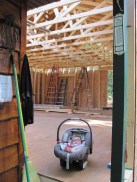 Some people thought we were crazy to do it but we just got back from a week at my parent’s Adirondack escape (ending last Sunday 7/11/2010).� This was Delilah’s first trip to the Adirondacks and it was a hot one.� She did great, slept a lot (it was in the 90’s with no A/C, ugh!) and smiled at her daddy a ton.
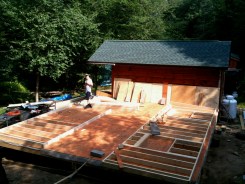 Last week when we got to camp Dad was already all the way up to laying the floor.� It might not sound like much, but there’s a ton involved to get to that point.� Squaring everything up, leveling (& digging) the ground, insulation, wire netting, studding, joists & beams… Not simple work.� He’d been working for over a month just about steady to get to that point.� These things take time, especially when you’re by yourself in the mountains and you’re fighting the rain nonstop.
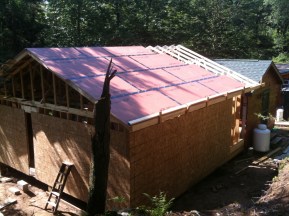 Not bad for 5 days worth of work for 2 guys in 90+�F heat and 2 days with a bunch of help from other family.� Thanks Jerry, Scott, Donald, Wes, Pauline, Virginia, Gage & Mindy Lee!� Still lots to do, but we’re getting pretty darn close to weather-sealed.� We’re only a few steps away: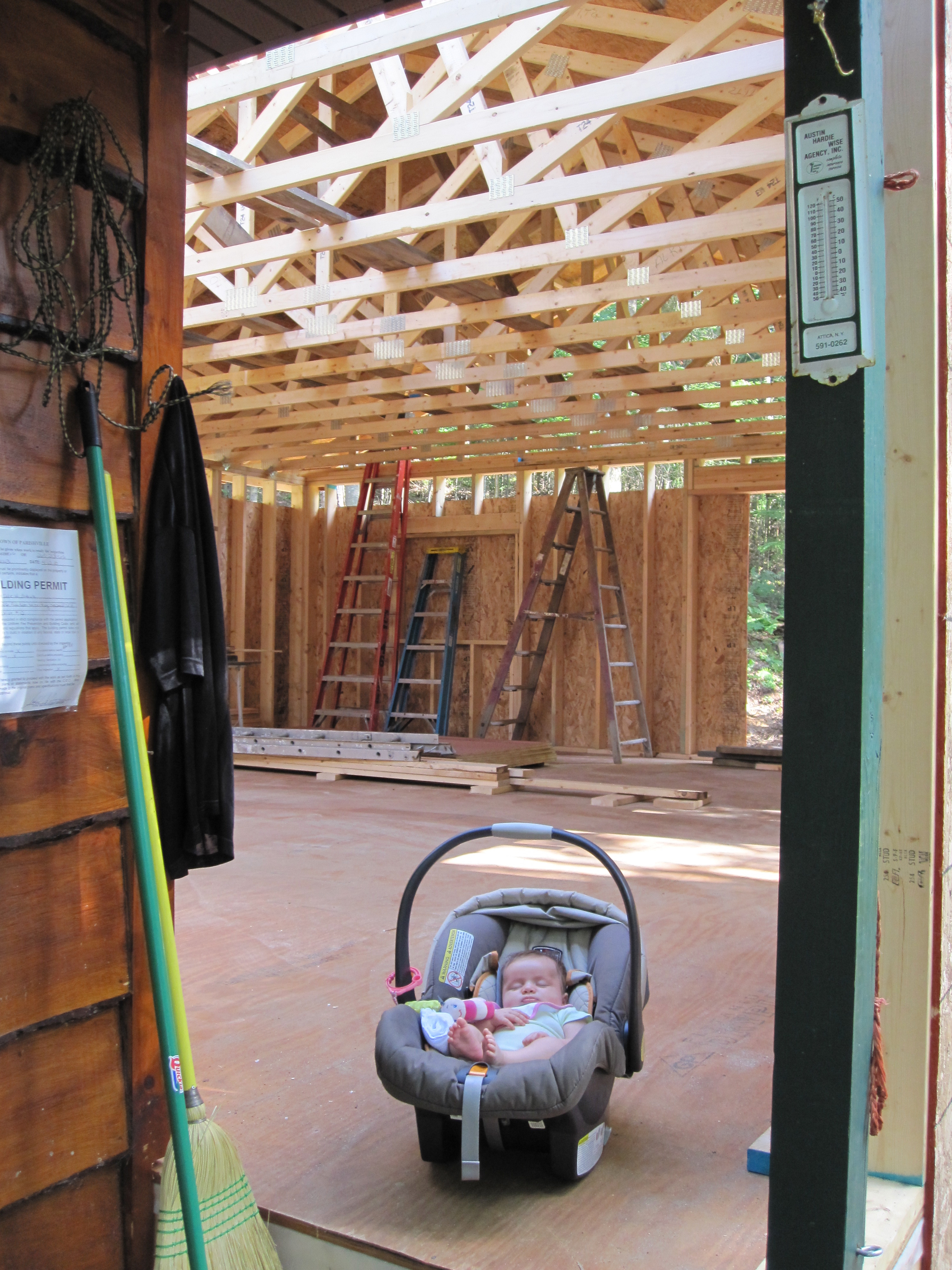






 Looking for possible reasons why the
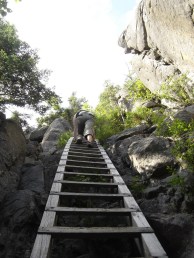 While not the tallest mountain we’ve climbed, it was pretty intense with several incredibly steep rocky sections. One of the steepest sections even had a ladder, which was good because being our first mountain together… we didn’t exactly have scaling equipment.
 As is always the truth in the Adirondacks, the views from the top were simply amazing. It was on this climb that we really learned how rewarding such a strenuous hike can be. On our way back down we passed by a little pond and it was so hot we were going to take a dip. However; when we took a closer look we realized it was infested with leaches. Nice!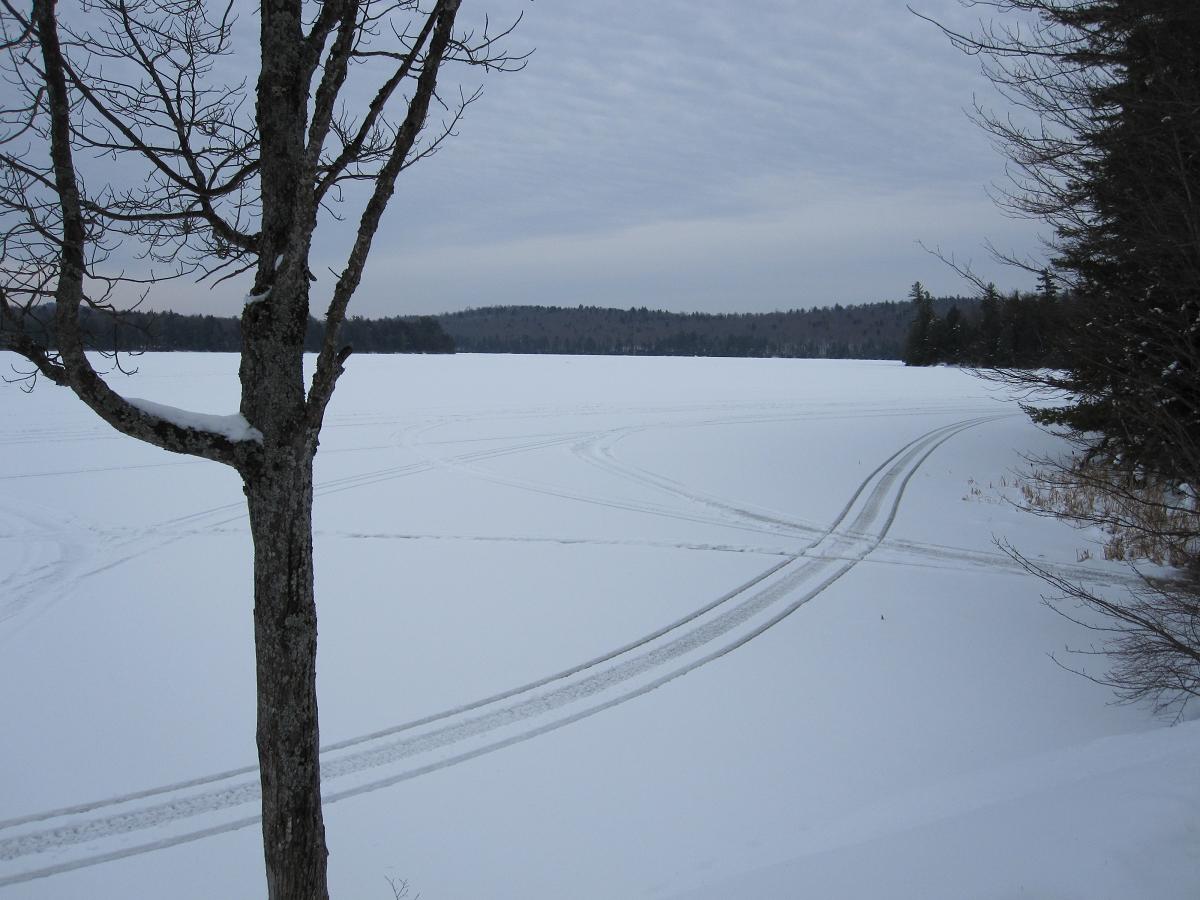
 Randy Aldrich